

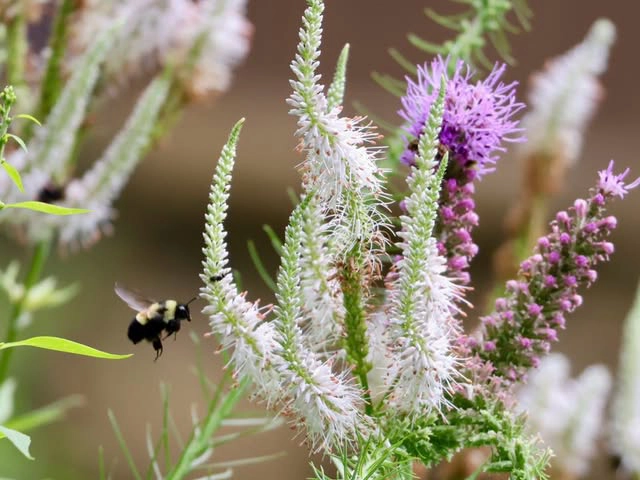
Posted by Judy Cardin on the “Wisconsin Midwest Bumble Bee” Facebook Group
Yard talk time We are at peak flower bloom and pollinator population in our Madison WI yard right now. I hope most people that weren’t seeing bumble bees earlier in the summer are seeing some now. We host many bees and pollinators throughout the season in our urban yard, and bee business is booming right now. We converted most of our yard to native habitat to support a native ecosystem, and see thousands of native pollinators daily in our yard: eleven species of bumble bees, and hundreds of species of butterflies, birds, native bees, moths, flower flies, bugs and beetles, and predators snd parasites. They are all important to a balanced native ecosystem. The less we interfere with them, the healthier the environment.
The principles we follow in our 1/4 acre urban yard have produced an incredibly diverse ecosystem. We are grateful for our urban sanctuary, the life it supports, and the hope it represents. I share what we did to help others accomplish the same in their yard. We can each make a tremendous difference in our yards, and together, we can help save imperiled species. Our words and actions do matter, and your yard can be the universe for many small pollinators. You are welcome to tour our living classroom when you are in Madison to help with ideas, or to just enjoy the haven.
The principles we follow in our urban yard:
1. Diverse native flowers, sedges, grasses, shrubs and trees that grow densely at all vertical levels and are native to our ecoregion. Drifts of flowers that bloom successively from April through October. We kept some nonnatives that pollinators use heavily or have sentimental value, but our yard is over 80% native. As we remove a hosta, we plant a native shrub. Every year over the last decade, we considered how much turf lawn we actually used, and assessed what we thought we needed. Every year we converted another corner of turf grass to native habitat, and replaced some nonnative garden plants with natives. Our front yard now is pollinator lawn aisles through native plantings, and a woodland back yard with wood chipped trails. Our grandkids can watch bumble bees on flowers, monarch caterpillars munching on milkweed, and birds bringing insects to the babies in their nests. Marlo loves to watch with us, and helps fill our water trays, and picks and eats the fresh wild strawberries and black raspberries. You decide what’s right for you, but please choose a corner of turf grass to convert to native habitat. Every native plant supports native life. See the end of this post for links to native plants suggestions.
Smothering Turf Grass for Native Plantings- Step by Step Guide by Judy Cardin https://foamadison.org/wp…/uploads/2026/01/IMG_8181.jpg
2. Zero pesticides, including insecticides, herbicides, fungicides and rodenticides. Plants should have holes in their leaves in a healthy ecosystem! All of these -cides are formulated to disrupt biological processes, and can cause significant harm to all forms of life. They harm insects by either direct mortality, or potential serious sublethal effects. I am so saddened when someone explains they want to protect their family from tick and mosquito borne illnesses and spray their yards with insecticides because they take Lyme disease seriously. We take Lyme disease seriously too, and don’t find ticks in our yard. We do daily tick checks to ensure a lone tick didn’t get dropped in our yard. We have a fan running on our patio when we entertain that works beautifully to disperse mosquitoes. We don’t expose plants, wildlife, growing children, guests or ourselves to the harmful chemicals in -cides. We take their and our health very seriously. See the links to Xerces info on pesticide use at the end of this post.
3. Leave native habitat areas natural. Skip fall and spring cleanup, and allow vegetation to decompose naturally- leave the leaves, stems, dead wood, and rodent holes in your native habitat areas. Bees, butterflies, moths, fireflies, birds and beneficial insects use this habitat for food, nesting, hibernation and shelter. Your soil will be enriched naturally by the decomposing material. That’s how Mother Nature fertilizes! We use no fertilizers at all.
I will post more pics today of what is blooming now in our yard. Here are some links if you would like to learn more. 8/13/26
First, native plant lists I compiled that support native pollinators- check for nativity in your ecoregion
April-May Bumble Bee Flowers
https://drive.google.com/…/1V…/view…
June-August Bumble Bee Flowers
https://drive.google.com/…/126zAHd7arg88srDki8p…/view…
Sep-Oct Bumble Bee Flowers
https://drive.google.com/…/1DRvIFNgsCdNNQrTG3d9…/view…
Garden Mix Kits curated for the Friends of the UW-Madison Arboretum by Judy Cardin:
Patio Prairie Container Kit
https://foamadison.org/wp…/uploads/2026/04/Container.jpg

Endangered Rusty Patched Bumble Bee Kit
https://foamadison.org/wp…/uploads/2026/04/RustyPatch.jpg

Shade Pollinator Kit
https://foamadison.org/…/2026/04/ShadePollinator.jpg

Sunny Pollinator Kit
https://foamadison.org/…/2026/04/SunnyPollinator.jpg

Woodland Spring Flower Kit
https://foamadison.org/wp…/uploads/2026/04/Woodland.jpg

Green Mulch Grass and Sedge Kit
https://foamadison.org/wp…/uploads/2026/04/GreenMulch.jpg

Pesticide information for urban yards from Xerces Society:
https://xerces.org/…/24-004_Rethinking%20Weed…
https://xerces.org/…/19-034_01_Protecting%20Pollinators…
Xerces guide to buying bee safe plants:
https://xerces.org/…/19-053_Buying%20Bee-Safe%20Nursery…
Xerces guide to Helping stem nesting bees
https://xerces.org/…/publications/22-005_01_web-press.pdf
Xerces guide to Nesting and Overwintering Habitat for Pollinators