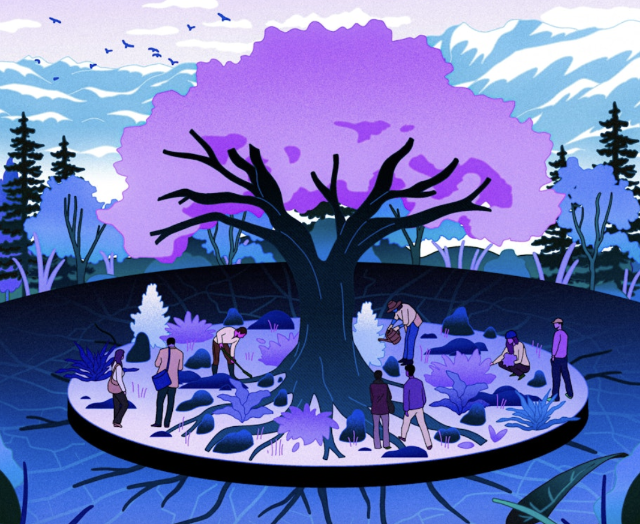
A growing ecological movement sees the solution in bioregionalism: the idea of reorganizing social and economic life around the natural boundaries of the ecosystems that host and sustain us. Rather than accepting the abstract placemaking of property or state, bioregionalists look to watersheds, biodiversity, human culture and other aspects of physical and social geography. Well-known bioregions in North America include Cascadia (reaching roughly from the southern tip of Alaska to northern California) and the Ozarks(primarily encompassing southern Missouri and northern Arkansas).
After emerging some 50 years ago, bioregionalism lost steam around the turn of the century. Today, however, it is in the midst of a resurgence. In light of the escalating pressures of the Anthropocene, many in the movement are now embracing bioregional finance (BioFi) — new financial systems and decentralized technologies to establish the technical, institutional and cultural bases for bioregional forms of economics and governance.
It’s a grand vision with ideas that may sound naively ambitious or even controversial, like using cryptocurrency to tokenize protected forest lands and incentivize their conservation. Proponents argue that such approaches can provide a means of affording visibility and value to ecosystems too often ignored by mainstream economics. The mission is to leverage existing economic systems in ways that prioritize bioregional regeneration over extraction.
“There’s a kind of dual edge to bioregionalism,” BrandonLetsinger, a leader in the Cascadian movement, told me. “One is short-term and pragmatic, working within existing systems, and the other is long-term and utopian — really working to outgrow, overgrow and build institutions that we don’t currently have, but that we need.”
A Meeting By The River
It was a cold, rainy weekend outside the Georgetown Steam Plant in late spring 2025; inside was damp and somehow even colder. The loading area of a decommissioned power station would make an unusual venue for most gatherings, but for the inaugural Cascadia BioFi Conference, it was an appropriate setting.
The towering power plant was built in 1906, just south of Seattle. About a mile to the west is the Duwamish River, where for millennia the Duwamish, Coast Salish and other Indigenous peoples practiced sustainable ways of life. The Duwamish flows into the Salish Sea, a sprawling system of waterways and watersheds connected to the Pacific Ocean by the broad-shouldered Strait of Juan de Fuca.
As industry insinuated itself around Seattle in the early 20th century, the river was straightened, its mud flats drained, its banks paved over and its biodiversity devastated. The Duwamish is now a registered superfund site. Efforts are underway to restore the life of the river and the areas around it, including the steam plant.
“When we talk about regeneration, that conversation has to start here,” Letsinger, who helped organize the conference, said in his opening remarks. He wore a baseball cap emblazoned with the silhouette of a Douglas fir tree framed by a rainbow, an inclusive variation on the popular symbol of Cascadia known as the “Doug flag,” which was ubiquitous throughout the drafty power plant.
Letsinger made the case for how, if properly organized and mobilized, the Cascadian bioregion could leverage significant resources and influence. Home to many leading technology companies as well as a significant proportion of the logging industry, it is also host to an outsized concentration of carbon-storing forests and some of the scarce remaining old growth on Earth. Washington state alone boasts one of the largest economies in the country.